Digital advertising is not just about ensuring that your advertisement is seen by as many people as possible. Instead, businesses want to know the following question: Did our advertising create the results that we wished for after implementing such an advertising campaign?
Are the clicks to our advertisement resulting in the desired actions? Are our customers performing the necessary actions to acquire our products? Are we spending the appropriate amount of money to receive these customers? Are we making the amount of revenue that we require from these customers?
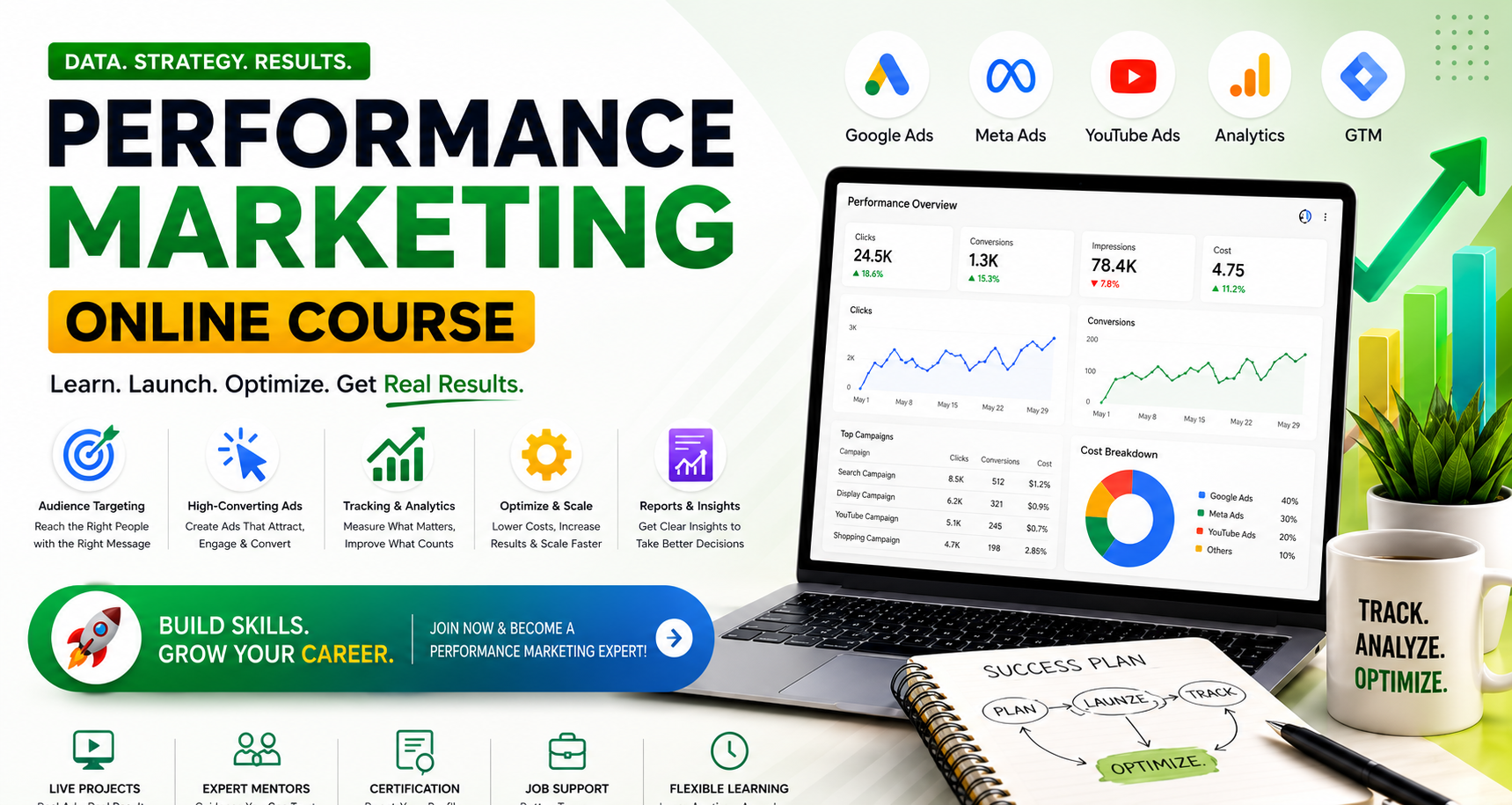
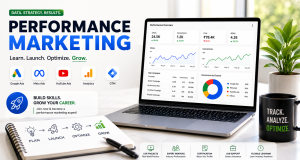
This is the importance of performance marketing. A performance marketing online course will introduce beginners to the industry to learn how pay-for-click and pay-for-installation advertisements are planned, launched, and measured for success. Instead of simply learning how to create advertisements, these beginners will learn how advertisements can be connected to the desired outcomes of the companies that create those advertisements.
Modern performance marketing goes beyond Google Ads and Facebook Ads to include automation, conversion tracking, analytics, landing pages, audience data, and AI.
What Is Performance Marketing?
Performance marketing means focusing on the measurable outcomes of an advertising campaign. Instead of measuring the likes and comments on a social media post, performance marketing measures website visits, leads, sales, and revenue.
Let’s say a coaching institute spends ₹20,000 on ads. Based on the ads:
- The ad receives 10,000 impressions
- Gets 800 clicks
- Yields 80 leads
- Results in 10 admissions
A performance marketer does not stop with the statistics that read “We got 800 clicks.” Instead, they ask:
- How much did each click and lead cost?
- Which campaign brought the best leads?
- Which audience brought the best results in terms of conversion?
- What was the final revenue and ROAS of each campaign?
- Should the budget be increased or reallocated to certain campaigns?
This is the mindset a good performance marketing course should teach.
Key Skills You Will Learn in a Performance Marketing Course
Performance Marketing Fundamentals
Understanding the basics of how performance marketing works across the digital world.
- Digital advertising vs. organic marketing
- Marketing funnels (TOFU, MOFU, BOFU)
- Paid campaigns vs. organic social media campaigns
- Campaign objectives and goals
Setting Marketing Goals and KPIs
A campaign must always start with a goal. Without understanding what the campaign is trying to achieve, it is impossible to properly optimize the campaign.
| Metric | Simple Meaning | Why It Matters |
| CTR | Click-Through Rate | The percentage of people who click on your ad. Measures the effectiveness of your ad copy and title. |
| CPC | Cost Per Click | The cost of each click on your ad. Lower costs are better; helps to assess the efficiency of your campaign. |
| CPM | Cost Per Mille | The cost of every 1,000 impressions of your ad. Lower costs are better; indicates how cost-effective your ad is. |
| CPL / CPA | Cost Per Lead / Action | The cost of acquiring a target lead or business action. Helps measure the effectiveness of lead generation campaigns. |
| CAC | Customer Acquisition Cost | The total cost of acquiring a paying customer. Lower costs are better; helps to understand the efficiency of sales and marketing efforts. |
| ROAS | Return On Ad Spend | The revenue generated relative to your advertisement spend. Higher ratios are better; indicates the effectiveness of your advertising budget. |
| Conversion Rate | Conversion Percentage | Percentage of users that perform the desired action. |
Formula Example: ₹10,000 spent on ads yields ₹40,000 in revenue for a 4x return on ad spend (ROAS) ($\text{Revenue} \div \text{Ad Spend}$).
Google Ads Mastery
Beyond launching Google Ads campaigns, training includes creating different types of campaigns including:
- Search, Display, YouTube, Shopping, and Performance Max (PMax) campaigns
- Understanding search intent and creating compelling ad copy
- Using conversion tracking and audience remarketing
Keyword Research and Search Intent
Keywords inform search ad campaigns. Training includes understanding different types of search intent including:
- Informational: the user searches for information on a topic such as “what is digital marketing”
- Commercial: digital marketing course
- Transactional: best digital marketing course Ahmedabad fees
Skills include knowledge of keyword grouping, match types (broad, phrase, exact), negative keywords and search term analysis.
Meta Ads (Facebook & Instagram)
Meta Ads Manager is used to create both leads and sales on Facebook and Instagram.
- Campaign creation and objectives for auction
- Audience research and targeting
- Custom Audiences and Lookalike Audiences
- Creative assets for ads
Advanced Audience Targeting
Showing the right advertisement to the right person prevents wasted ad spend.
Targeting options include:
- Location-based targeting – show ads to a specific radius on the map, for example, to people in Ahmedabad
- Behavioral, interest, and demographic targeting
- Using a first-party customer list to target people who may be interested in your products
- Targeting people based on their engagement or website interaction with your brand
Retargeting and remarketing strategies can target people who visited your website before but did not take the desired action on their first visit to your brand. Retargeting can target:
- People who visited your website or viewed products
- People who added items to their shopping cart but did not complete their purchase
- Previous customers
- People who watched advertisement videos on your website or social media platforms
Ad copywriting and creative strategy for performance marketing campaigns depend on capturing the viewer’s attention immediately.
Winning Ad Copy Formula:
Problem $\rightarrow$ Benefit $\rightarrow$ Proof $\rightarrow$ Call to Action (CTA)
Landing Page Optimization (CRO)
Even with great ad copy, a slow or confusing landing page will ruin your campaign. You’ll learn to assess landing pages for:
- Strong headline that matches the message in your ads
- Simple form that is mobile responsive and fast loading
- Social proof and calls to action on the landing page
Technical Conversion Tracking
You can’t measure the value of your campaigns without proper tracking.
Ad Click $\rightarrow$ Landing Page Visit $\rightarrow$ Form Submission $\rightarrow$ Conversion Tag Fires $\rightarrow$ Analytics Dashboard
Learners study about conversion events, tracking purchases made on a website, tracking calls made to a phone number, conversion values, and attribution models for marketing activities.
Google Analytics 4 (GA4)
GA4 assists marketers in analyzing the behavior of website visitors after they have arrived on the website.
- Traffic acquisition sources and journeys
- GA4’s capabilities to track events and conversions
- Using the current attribution models to determine the success of marketing campaigns
Google Tag Manager (GTM)
GTM allows marketers to manage website tags without the assistance of web developers.
- Configuring GTM tags and variables
Meta Pixel and Conversions API (CAPI)
Modern tracking uses both browser and server-side tracking with Meta Pixel and Conversions API for optimal data reporting and tracking.
Budget Planning, Bidding, and AI Automation
Efficient ad spending requires proper budget planning and AI automation tools such as:
- Smart bidding algorithms in Google Ads
- Meta Advantage+ campaign automations
- Correct budget distribution across advertising platforms based on CPA and ROAS targets
Campaign Optimization & A/B Testing
Launching a campaign is just the beginning of the advertising process. Optimizing campaigns requires finding and fixing bottlenecks in the customer funnel. If your campaigns have a high cost-per-click but a low click-through rate, for example, your creatives might need improvement.
High CPL but low conversion rate means landing page needs to be refined or keyword match types need to be altered.
A/B testing can be used to test different variables for websites and campaigns.
Performance Reporting and Business Economics
Reporting on campaigns and ads can help make business decisions. Specifically, dashboards can be built using Google Ads, Meta, GA4, and Looker Studio to display important metrics for advertising campaigns. These metrics can be correlated with profit margins, CAC, and CLV. Reports can display the data for campaigns (what happened), why it happened, and the actions to take going forward.
AI Tools and Workflow Integration
Several AI tools can be used in the advertising workflow to make the process easier and more efficient:
- Generating ad copy variations and creative concepts
- Audience research and competitor analysis
- Data analysis, reporting summaries, and campaign troubleshooting
Practical Hands-On Campaign Projects
The best way to learn is by doing. Therefore, there are several campaign projects that you can undertake to give you more experience in this area:
- Select a business
- Define the goals that the company wants to achieve
- Choose the audience and the channels through which the ads will run (Google Search and Meta Ads)
- Build the ad campaign elements (keywords, ad copy, creative assets, landing pages)
- Implement tracking for the ads
- Analyze the campaigns and optimize the ads accordingly
Essential Tools Taught in the Course
| Tool | Primary Industry Purpose |
| Google Ads | Search, Video, Display, & PMax advertising |
| Meta Ads Manager | Facebook & Instagram ad campaigns |
| GA4 | Website analytics & conversion tracking |
| Google Tag Manager | Tag and tracking event management |
| Google Keyword Planner | Search volume & keyword intent research |
| Looker Studio | Custom client performance reporting dashboards |
| Meta Pixel & CAPI | Event measurement & web data tracking |
Frequently Asked Questions (FAQs)
Is a Performance Marketing Online Course suitable for beginners?
Yes. A beginner-friendly course will teach the basics of performance marketing before diving into the different platforms.
Do I need coding skills to learn performance marketing?
No. You do not need to know advanced coding concepts. However, having a basic understanding of technical concepts will help you better understand the data that will be available to you in the future.
What is the difference between CPC and CPA?
CPC stands for cost per click. This metric shows the advertiser the cost that is incurred each time someone clicks on the advertisement.
CPA stands for cost per acquisition. This metric represents the cost that is incurred by the advertiser to acquire a specific number of converting customers or leads.
What is ROAS and how is it calculated?
ROAS stands for return on advertisement spend. The formula for calculating an advertiser’s ROAS is as follows:
$$\text{ROAS} = \frac{\text{Revenue Generated from Ads}}{\text{Total Advertising Spend}}$$
Final Summary
Performance marketing is not just about creating advertisements for your company’s products or services. It is also about understanding your company’s objectives and ensuring that your advertisements are targeted towards the right audience to deliver the best possible results.
A structured Performance Marketing Online Course will give you the skills and knowledge required for every aspect of creating profitable advertising campaigns.
Conclusion
A Performance Marketing Online Course will give you the skills that are required today to work in the digital advertising industry. Such courses will allow you to learn about platforms like Google Ads and Meta Ads, audience targeting, conversion tracking, analytics, and more.
However, taking the course is only the beginning. The best way to master the industry is to begin working on your advertising campaigns and learning as much about the industry as possible. So choose your course wisely and seek out projects, training, and education on the current digital advertising tools and analytics.
The goal of this course will be to learn the skills, gain experience in the field, building a portfolio of work, and confidence in managing marketing campaigns based on the results from previous campaigns.