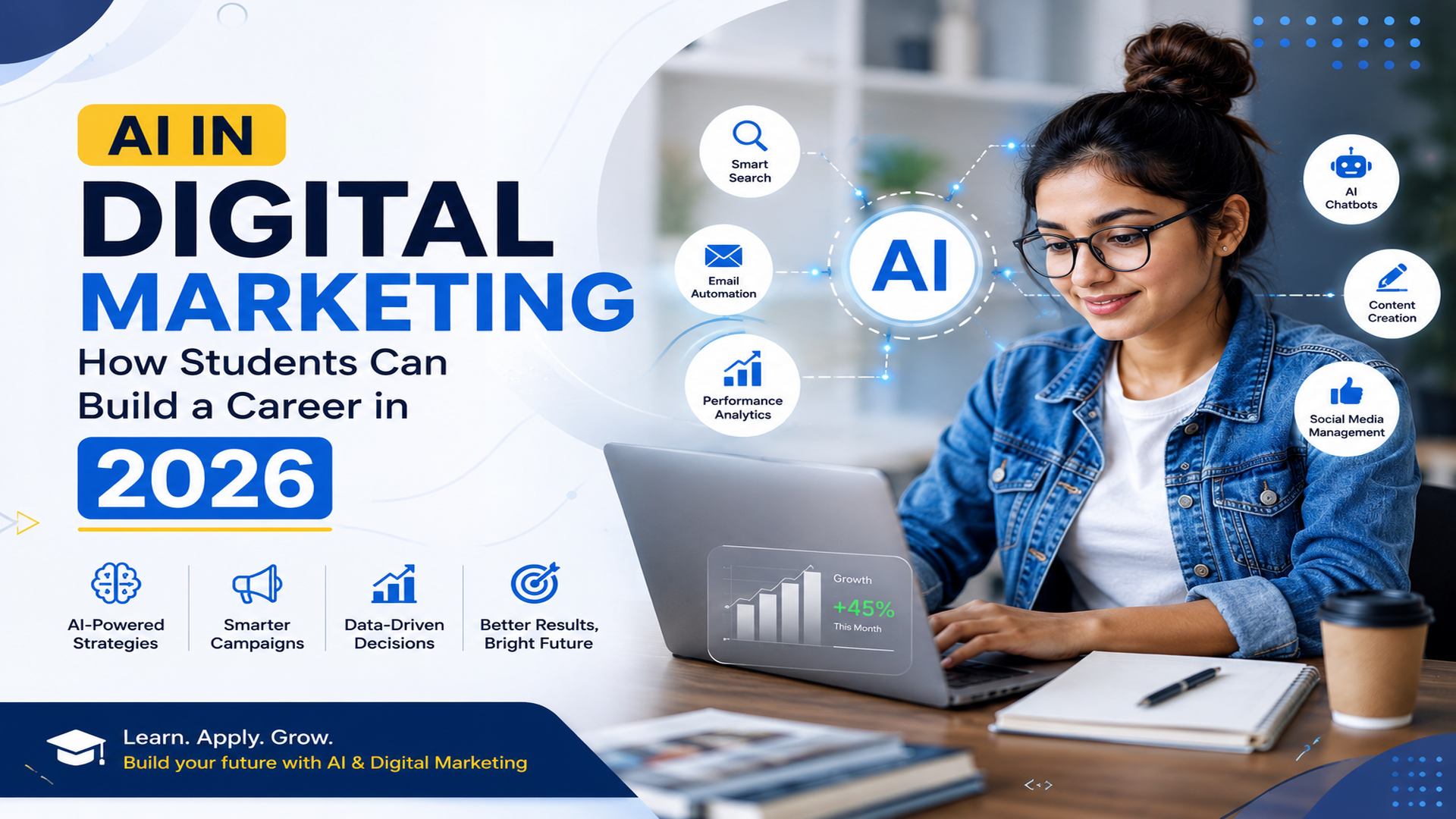
Artificial Intelligence (AI) is changing almost every industry, and digital marketing is one of the biggest examples. Tasks that once took hours can now be completed in minutes with AI-powered tools. Businesses use AI to understand customers, create content, run ads, and improve marketing performance.
For students in India, this shift is creating exciting career opportunities. Companies are looking for marketers who understand both digital marketing and AI tools. According to recent industry reports, AI-related marketing skills are becoming increasingly important in hiring decisions. AI knowledge is now one of the fastest-growing skill requirements in marketing jobs.
If you’re wondering whether digital marketing is still a good career in the AI era, the answer is yes. The key is learning how to work with AI instead of competing against it.

What is AI in Digital Marketing?
Before exploring careers, let’s answer a common question: What is AI in digital marketing?
AI in digital marketing refers to the use of artificial intelligence technologies to automate, improve, and optimize marketing activities. AI systems can analyze large amounts of data, identify patterns, predict customer behavior, and generate content faster than humans.
Examples include:
- AI chatbots answering customer questions
- AI tools creating social media posts
- Personalized product recommendations
- Predictive customer analysis
- Automated email campaigns
- AI-powered advertising optimization
Instead of replacing marketers, AI acts like a smart assistant that helps them make better decisions.
Why AI is Changing Digital Marketing Faster Than Ever
Digital marketing generates huge amounts of data every day.
Businesses need to know:
- What customers want
- Which ads perform best
- Which keywords drive traffic
- Which content converts visitors
AI helps analyze this data instantly.
Modern AI systems can:
- Process millions of customer interactions
- Predict future buying behavior
- Personalize marketing messages
- Improve ad targeting
- Automate repetitive tasks
Many organizations report significant efficiency improvements through AI-powered marketing automation. Recent industry examples show AI reducing campaign execution time dramatically while maintaining high accuracy.
This is why marketers who understand AI are becoming highly valuable.
As AI continues to transform digital marketing, students should also understand how AI search differs from traditional Google Search. Read this detailed guide on AI Search vs Google Search: The Shocking Visibility Gap to learn how search visibility is changing.
Examples of AI in Digital Marketing
Understanding real-world applications helps students see where opportunities exist.
1. AI Content Creation
Tools like ChatGPT, Gemini, and Claude help marketers:
- Generate blog ideas
- Write social media captions
- Create email campaigns
- Draft ad copy
Human review is still necessary, but productivity increases significantly.
2. AI-Powered SEO
SEO professionals use AI to:
- Find keywords
- Analyze competitors
- Generate content outlines
- Improve search visibility
- Optimize meta descriptions
3. AI Advertising
Platforms like Google Ads and Meta Ads use AI to:
- Target audiences
- Optimize budgets
- Improve conversion rates
- Predict campaign performance
4. Email Marketing Automation
AI helps:
- Personalize subject lines
- Predict open rates
- Recommend products
- Segment subscribers
5. Customer Support Chatbots
Many websites now use AI chatbots that answer customer questions 24/7.
How Do You Use AI in Digital Marketing?
Many beginners ask: How do you use AI in digital marketing?
The process is simple:
Step 1: Collect Data
Gather customer information from:
- Websites
- Social media
- Email campaigns
- CRM systems
Step 2: Analyze Data
AI identifies:
- Customer interests
- Buying patterns
- User behavior
Step 3: Create Marketing Strategies
Marketers use AI insights to:
- Build campaigns
- Improve content
- Optimize ads
Step 4: Automate Tasks
AI automates:
- Reporting
- Content suggestions
- Ad optimization
- Customer responses
Step 5: Monitor Results
Humans review performance and adjust strategies.
This combination of AI and human creativity delivers the best results.
Key AI Applications Every Student Should Know
Customer Segmentation & Behavioral Targeting
Customer segmentation means dividing audiences into groups based on interests, demographics, or behavior.
AI can analyze thousands of users and identify patterns instantly.
For example:
An online clothing store may create segments such as:
- Students
- Working professionals
- Frequent buyers
- First-time visitors
Each group receives personalized marketing messages.
Case Study & ROI Impact
Brands using personalized targeting often see higher engagement and conversion rates because customers receive more relevant content. AI-driven segmentation improves marketing efficiency by reducing wasted advertising spend.
Chatbots & Virtual Assistants
Chatbots are among the most visible examples of AI in digital marketing.
Benefits include:
- Instant customer support
- Lead generation
- Product recommendations
- Appointment booking
They work around the clock without human intervention.
Case Study & ROI Impact
A chatbot can answer hundreds of customer questions simultaneously, reducing support costs while improving customer satisfaction.
Predictive Analytics & Recommendation Engines
Predictive analytics uses historical data to forecast future behavior.
Examples:
- Predicting which customers may buy
- Identifying churn risk
- Forecasting campaign performance
Recommendation engines are used by:
- E-commerce stores
- Streaming platforms
- Learning platforms
Case Study & ROI Impact
AI recommendations increase sales because customers discover products that match their interests.
Content Curation, Generation & Personalisation
Generative AI tools help marketers create:
- Blog articles
- Email campaigns
- Social media posts
- Ad copy
AI can also personalize content for different audiences.
Case Study & ROI Impact
Personalized content generally produces better engagement than generic messaging because it addresses individual user interests.
Best Free AI Tools for Digital Marketing
Students don’t need expensive software to start learning.
Here are some of the best free AI tools for digital marketing:
| Tool | Use Case |
| ChatGPT | Content creation |
| Gemini | Research and brainstorming |
| Canva AI | Design creation |
| Google Analytics | Data analysis |
| HubSpot Free CRM | Customer management |
| Grammarly | Content improvement |
| Notion AI | Productivity |
| Copy.ai | Marketing copy |
| Perplexity | Research |
| Google AI Studio | AI experimentation |
Many of these tools offer free plans that are perfect for students.
Most Common Skills Used in AI-Driven Digital Marketing
Students often ask about the most common skills used in AI-driven digital marketing.
Technical Skills
- SEO
- Google Analytics
- Google Ads
- Meta Ads
- Marketing Automation
- Prompt Engineering
- Data Analysis
- AI Tool Usage
Creative Skills
- Copywriting
- Content Strategy
- Video Marketing
- Storytelling
- Branding
Soft Skills
- Communication
- Problem Solving
- Critical Thinking
- Creativity
As AI becomes more common, creativity and judgment become even more valuable. Industry leaders increasingly emphasize that human insight remains a major competitive advantage.
Step-by-Step Career Roadmap for Students
Year 1: Learn Fundamentals
Study:
- SEO
- Social Media Marketing
- Google Ads
- Content Marketing
- Email Marketing
Learn AI Tools
Practice:
- ChatGPT
- Gemini
- Canva AI
- Analytics tools
Create personal projects.
Build a Portfolio
Show:
- Blog articles
- Marketing campaigns
- SEO reports
- AI-generated marketing experiments
Gain Real Experience
Apply for:
- Internships
- Freelance projects
- Agency positions
This is where training institutes such as WhatAdverts can help students gain practical experience through live projects.
Specialize
Choose a niche:
- AI SEO Specialist
- Performance Marketer
- Content Strategist
- Marketing Analyst
- Growth Marketer
Pros and Cons of AI in Digital Marketing
Many people ask about the pros and cons of AI in digital marketing.
Pros of AI in Digital Marketing
Faster Work
AI reduces repetitive tasks.
Better Personalization
Customers receive relevant experiences.
Improved Data Analysis
AI processes large datasets quickly.
Higher Productivity
Marketers accomplish more in less time.
Better Decision Making
AI provides useful insights.
Cons of AI in Digital Marketing
Content Quality Risks
AI-generated content can sometimes be inaccurate.
Lack of Human Creativity
AI cannot fully understand emotions and culture.
Privacy Concerns
Businesses must handle customer data responsibly.
Overdependence on Automation
Too much automation can reduce authenticity.
Learning Curve
Professionals must continuously update skills.
Understanding both the advantages and limitations helps students become better marketers.
Will AI Replace Digital Marketers?
This is probably the biggest concern among students.
Short Answer: No
AI will replace some repetitive tasks.
It will not replace:
- Strategy
- Creativity
- Brand building
- Emotional storytelling
- Customer relationships
The future belongs to marketers who know how to use AI effectively.
Think of AI as a calculator.
Calculators didn’t replace accountants.
They made accountants more productive.
Similarly, AI won’t eliminate digital marketing careers. Instead, it will transform them.
Future of AI in Digital Marketing
The future of AI in digital marketing looks extremely promising.
Several trends are shaping the industry:
AI Search Optimization
Businesses are optimizing content for AI-powered search experiences.
Hyper-Personalization
Marketing messages will become more tailored to individual users.
AI Agents
AI assistants will handle more marketing workflows automatically.
Predictive Marketing
Campaigns will increasingly use forecasting and predictive analytics.
Conversational Commerce
Customers will interact with AI assistants before making purchases.
AI-Powered Content Production
Content creation will become faster while human editors focus on quality and strategy.
Industry experts and major technology companies continue investing heavily in AI-powered marketing solutions, indicating strong future demand for AI-skilled marketers.
To understand how generative AI is changing SEO and shaping the future of digital marketing, explore this guide on Generative AI in SEO
FAQs
What is AI in digital marketing?
AI in digital marketing refers to using artificial intelligence technologies to automate marketing tasks, analyze data, personalize customer experiences, and improve campaign performance.
Which AI tools should students learn first?
Students should start with ChatGPT, Gemini, Canva AI, Google Analytics, and basic marketing automation platforms.
Is digital marketing a good career in 2026?
Yes. Demand for marketers with AI skills continues to grow as businesses adopt AI-powered marketing solutions.
Do I need coding skills for AI marketing?
No. Most AI marketing tools are beginner-friendly and do not require programming knowledge.
Can freshers get AI marketing jobs?
Yes. Many companies hire interns and entry-level marketers who understand digital marketing fundamentals and AI tools.
How long does it take to learn AI digital marketing?
Most students can learn the basics within 3–6 months and become job-ready within 6–12 months with consistent practice.
Conclusion
AI is not the future of marketing—it is already transforming how businesses attract, engage, and retain customers. For students in India, this creates a major opportunity. By learning digital marketing fundamentals, mastering modern AI tools, building practical experience, and developing creative problem-solving skills, you can position yourself for some of the most in-demand jobs of the coming decade. The students who learn how to work alongside AI today will become the marketing leaders of tomorrow, making AI in Digital Marketing one of the most valuable career paths to pursue in 2026 and beyond.