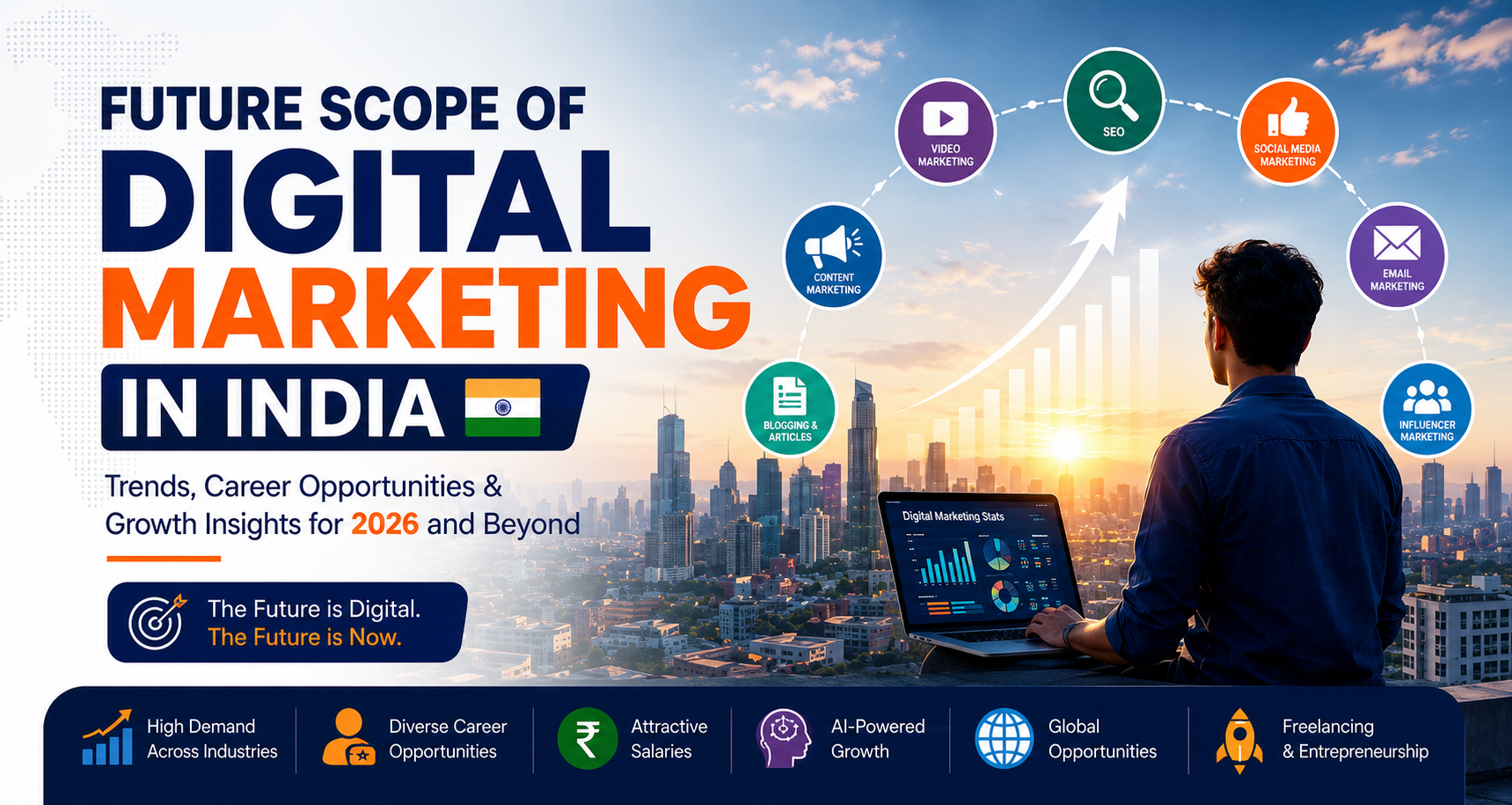
The digital landscape keeps changing in India due to better internet penetration, a youthful population embracing technology, and e-commerce. While digitization is being lapped up by the country, the scope of digital marketing increased manifold, offering floods of opportunities for enterprises and professionals. Let us delve into some thoughts on the future of digital marketing in India, covering key trends, challenges, and the essential skills required to thrive in this field.
1. Growing Importance of AI and Machine Learning in Digital Marketing
Artificial intelligence and machine learning are changing the face of digital marketing into hyper-personalized customer experiences. AI-driven algorithms supply the marketer with tools to anticipate consumer behavior. There will be streamlined customer services as provided by chatbots while recommendations are personalized; as a result, more customers are engaged. Take an e-commerce platform; how about AI offering them certain products based on prior search history and purchases for possible conversions
AI and personalization in digital marketing are in vogue. The ever-developing technology requires a marketer in India to learn how to access AI tools so as not to fall behind in its wake while meeting the emergent demands of the changing consumer.
2. Video Marketing and the Power of Visual Content
Video content, which was once considered more engaging than any other form of digital media, is again in the spotlight. Sites like YouTube, Instagram, and now Threads are becoming video-friendly, and videos are taking the world in short-form by storm to capture the attention of a billion Indians. Recent research indicates that a large segment of consumers prefer to read about products through videos than through text.
The rising trend in video viewing may provide benefits to businesses with appropriate video marketing strategies. Video marketing will continue producing good-quality relevant videos to engage with the target audience, especially with mobile-friendly formats. Video marketing keywords include search words related to visual content, as well as short-form video marketing, thus helping marketers rank better on the search engines and also more varied audiences.
3. The Rise of Voice and Visual Search Optimization
Optimization for voice, therefore, becomes essential for the future of SEO, as it is seen that an increasing number of voice-enabled devices-like Google Home or Alexa-find their way into Indian households. With growing numbers of consumers beginning to make search queries by way of voice commands, it becomes time for marketers to update their SEO strategies to incorporate conversational keywords and phrases within them.
Lastly, with the surge in visual search, customers are using images to search for similar products or gather information. For optimizing voice and visual search, marketers should work on NLP and image recognition techniques. Using keywords of voice search optimization and visual search in SEO positions the brands better leverage these rising trends.
4. Social Media Shopping and Influencer Marketing
Social media forms a very integral part of Indian consumers’ lives with the use of Instagram, Facebook, and WhatsApp. Buying directly from social platforms has grown rapidly, and with that, the consumer journey becomes more seamless, and new marketing channels for brands emerge. Instagram and Facebook have introduced “Shop” features through which businesses can reach out to customers through their profiles.
The most significant role for influencer marketing is currently being played by micro-influencers. Influencers can connect the brand to niche audiences and build much-needed trust, creating conversions. The keywords required for such campaigns are social media marketing, influencer marketing in India, and social commerce.
5. Data-Driven Marketing and Privacy Concerns
The more customer data is available, the more fundamental data-driven marketing is. Data analytics, through which marketers come to understand their consumer behavior, optimize campaign results, and measure effect, are becoming very pertinent. However, as that happens, the issues associated with privacy are rising also. Data privacy laws in India, like the recently announced Personal Data Protection Bill, are now in play to protect user information.
The strategy must align data-driven marketing with the transparency of what the business wants and respect on the consumer’s side for their consent. So, in addressing those topics, innovative yet very respectful of user privacy, some of the key buzzwords will be data-driven marketing and a privacy-first approach.
6. Augmented Reality (AR) and Virtual Reality (VR) in Customer Experiences
Augmented Reality and Virtual Reality are here to change the way customers interact in the Indian digital marketing landscape. From virtual try-ons for e-commerce to fully immersive brand experiences in virtual reality, these technologies let brands create more interactive experiences. For example, beauty brands can offer virtual makeup try-ons where a user gets a real-time experience with the product before purchase.
Indian brands would ultimately be able to discover fresh opportunities through AR and VR applications, particularly retail, real estate, or tourism. The use of AR in digital marketing or VR for customer experience focus keywords will help rank such searches related to futurism technologies.
7. Significance of Skills and Careers in Digital Marketing in India
Now, the demand for skilled digital marketers is increasing at rocket speed. Digital platforms and the digital media landscape make businesses look to invest in talent competent in SEO, content marketing, social media strategy, and data analytics. So, courses and certifications in digital marketing have become so much in demand that now even institutions provide specialized courses to upskill professionals.
With the growth in the industry, this is the time when increasing demands are made for skilled digital marketers with knowledge regarding advanced tools and technologies with AI and data analytics. For a professional to grow competitively, one can look at digital marketing courses, digital marketing careers in India, and SEO skills.
Conclusion:
An increase in technology adoption at alarming rates and shifting consumer behavior are factors that will, in turn, drive growth in the digital marketing industry in India. To take full advantage of these emerging trends, marketers must move as fast as the newest developments around AI, voice and visual searches, social commerce, and technologies. Quick adaptation will not only provide a competitive advantage but also present a chance for brands to be able to connect more meaningfully with Indian consumers.
As the scope of career opportunities expands by the growing industry, these are golden times for students looking forward to pursuing the field. With strategic planning, data-driven insights, and consumer-centric approaches, this is also looking bright, full of potential, shortly for Indian digital marketing.